



EMS documentation must meet NEMSIS v3.5.1 national elements, satisfy CMS medical-necessity rules for billing, and follow HIPAA-secure ePCR workflows. Start by locking in required fields and an auditable addendum process — everything else builds from that foundation.
Three actions your agency can take right now:
- Confirm required NEMSIS national elements in your ePCR template. Pull your vendor’s export against the NEMSIS v3.5.1 data dictionary and your state schematron file. Any gap is a compliance exposure.
- Enforce quantified clinical documentation. Every chart must show numeric vitals, GCS, and clinical rationale for transport level on the date of service. A physician order alone does not satisfy CMS medical-necessity requirements.
- Lock records and use addenda for corrections. Overwriting a locked chart is a legal and billing risk. Require a tracked addendum with timestamp, author, and reason for every post-lock change.
Thepscgroup works alongside agencies to operationalize each of these steps through policy templates, ePCR configuration oversight, and structured QA programs.
Table of Contents
- What are PCRs and ePCRs, and who sets the standards?
- What core data elements does every compliant ePCR require?
- How should you document clinical findings to support care and billing?
- How do you write an EMS narrative that holds up to scrutiny?
- How does transport documentation satisfy CMS medical-necessity rules?
- What do administrators need to enforce in ePCR systems and NEMSIS v3.5.1?
- How do you build a QA audit workflow that actually improves documentation?
- What legal, privacy, and retention rules govern EMS records?
- Practical templates and checklists your crews can use today
- How PSCG helps agencies operationalize documentation standards
- Key Takeaways
- Why documentation quality is a patient-safety and fiscal issue, not just a paperwork problem
- Thepscgroup’s documentation consulting services for EMS agencies
- Useful sources and links for EMS documentation compliance
What are PCRs and ePCRs, and who sets the standards?
The Patient Care Report (PCR) is the formal record of a prehospital emergency response. It captures patient demographics, chief complaint, clinical assessments, interventions, medications, timestamps, and disposition. Historically paper-based, the PCR now exists almost universally in electronic form as the Electronic Patient Care Report (ePCR), a structured digital record submitted through certified software platforms to state and national repositories.
StatPearls describes the PCR as serving at least five distinct functions: clinical handoff to receiving facilities, billing and reimbursement support, quality assurance and improvement, population health research, and legal defense. That breadth is exactly why documentation errors carry consequences across so many domains simultaneously.
Four bodies govern what goes into a compliant ePCR:
- CMS (Centers for Medicare & Medicaid Services): — Sets billing and medical-necessity documentation requirements for Medicare and Medicaid ambulance transport claims. CMS guidance is the primary driver of what clinical detail must appear in the chart to support reimbursement.
- NHTSA / EMS.gov: The National Highway Traffic Safety Administration publishes national EMS education standards, system design guidance, and instructional frameworks that shape training and competency expectations across agencies.
The practical implication: your ePCR must satisfy national NEMSIS elements, your state’s schematron validation rules, and any local policy requirements simultaneously. Vendor defaults rarely accomplish all three without agency-level configuration.
What core data elements does every compliant ePCR require?
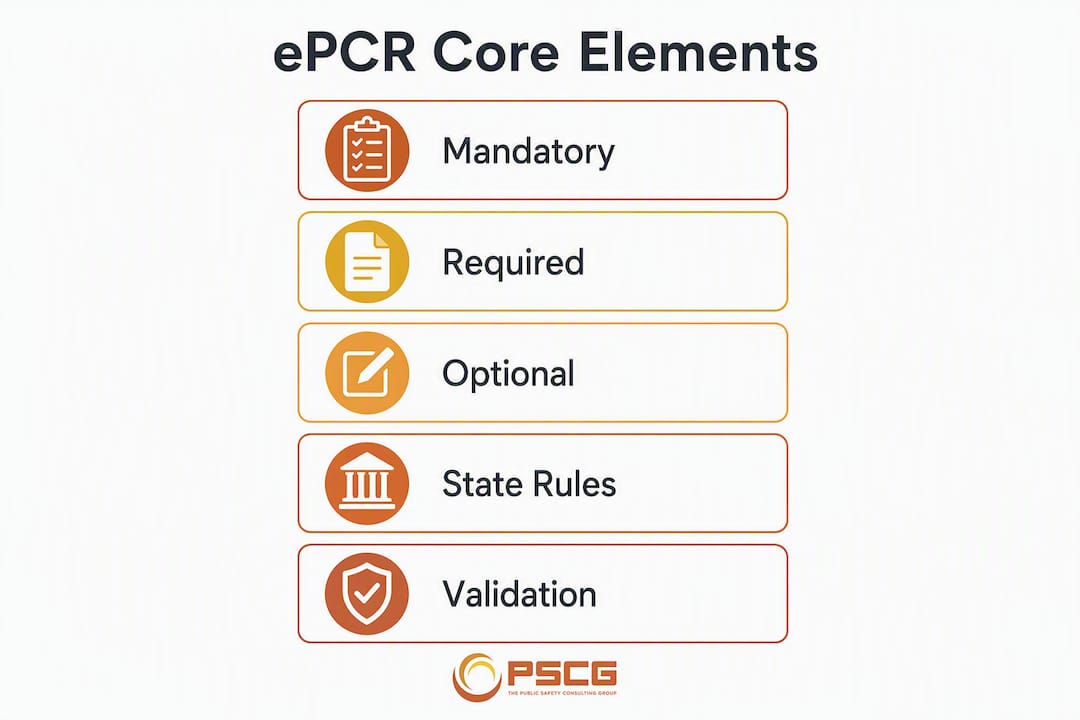
NEMSIS v3.5.1 organizes elements into usage levels: mandatory (must be present for the record to be accepted), required (expected unless a “Not Value” applies), recommended (best practice), and optional (agency or state discretion). The NEMSIS EMSDataSet Guide explains how state schematron files can elevate recommended elements to required status within a given jurisdiction.
| Section | Key Data Elements | NEMSIS Usage Level |
|---|---|---|
| Patient demographics | Legal name, date of birth, gender, race/ethnicity, home address | Mandatory / Required |
| Incident identifiers | Incident number, PCR number, agency identifier, unit identifier | Mandatory |
| Dispatch and response | Dispatch complaint, response mode, unit notified time, dispatch time | Required |
| Timestamps | PSAP call time, unit en route, unit on scene, patient contact, transport, arrival at destination, available | Mandatory / Required |
| Scene and location | Incident address, GPS coordinates, scene type, pick-up location type | Required |
| Crew identifiers | Lead provider name, certification level, crew member identifiers | Required |
| Patient assessment | Chief complaint, GCS (E/V/M), mental status, skin signs, pain scale | Required |
| Vitals | BP, pulse rate/rhythm, respiratory rate, SpO2, EtCO2, blood glucose, temperature | Required |
| Interventions | Procedures performed, device used, outcome, provider identifier | Required |
| Medications | Drug name, dose, route, time administered, response, IV site/catheter size | Required |
| Transport | Transport mode, transport disposition, destination facility, reason for transport | Required |
| Billing | Insurance type, Medicare/Medicaid number, medical-necessity indicators | Required |
Checklist for template reviewers:
- Export a sample ePCR from your vendor and map every field to the NEMSIS v3.5.1 data dictionary.
- Identify which elements your state schematron marks as required beyond the national baseline.
- Confirm “Not Values” (e.g., “Not Applicable,” “Not Recorded”) are configured correctly — missing a required element without a valid Not Value will fail schematron validation.
- Verify that GPS coordinates auto-populate from device location rather than relying on manual entry.
- Check that crew identifiers pull from your agency’s certified personnel roster, not free-text fields.
Pro Tip: Run a monthly export of 10 randomly selected charts against your state schematron file using NEMSIS’s open-source validation tools. Schematron failures that accumulate undetected become denial patterns at the billing stage.
How should you document clinical findings to support care and billing?
Clinical documentation is where most EMS charts either earn or lose their value. A chart that records “vitals stable, patient transported” tells an ED physician nothing useful and gives a CMS auditor no basis to approve the claim. Specificity is not optional.

Vital signs: minimum sets and trending
Record a complete initial vital sign set at first patient contact: blood pressure, pulse rate and rhythm, respiratory rate, SpO2, GCS (Eye/Verbal/Motor components separately), skin signs, and pain scale. For any ALS-level call or patient with a dynamic presentation, document at least one additional set of vitals after each significant intervention and at transport. Three data points create a trend; a trend tells the clinical story.
- Blood pressure: systolic and diastolic, not “WNL.”
- Pulse: rate and rhythm (regular, irregular, weak, bounding).
- GCS: document all three components numerically (e.g., E3V4M5 = 12), not just the total.
- SpO2: record pre- and post-oxygen therapy values to show response.
- EtCO2: required for any intubated patient; document waveform quality.
Medication documentation
Every medication entry must include drug name (generic), dose in numeric units, route of administration, time administered, provider who administered, IV access details (site, catheter gauge, number of attempts, fluid type and volume infused), and patient response. “Aspirin given” fails every standard. “Aspirin 324 mg PO at 14:23 by EMT-P Jones; patient tolerated without adverse effect” meets it.
Intervention documentation
State the clinical rationale for each intervention, not just the intervention itself. “12-lead ECG obtained due to chest pain with diaphoresis; ST elevation noted in leads II, III, aVF; medical control notified at 14:31” is defensible. “12-lead done” is not. Document the outcome of every intervention and identify the provider by name and certification level.
Pro Tip: Configure your ePCR to use validated dropdown fields for high-risk entries like medication names, routes, and catheter sizes. Free-text in these fields is the leading source of medication documentation errors flagged by ISMP and The Joint Commission. Reserve free-text for narrative and rationale fields where clinical judgment must be expressed.
How do you write an EMS narrative that holds up to scrutiny?
The narrative is the one place in the ePCR where the provider’s clinical reasoning appears in plain language. Structured data fields capture what happened; the narrative explains why. A well-written narrative can resolve an ambiguous chart; a poor one can undermine an otherwise complete record.
Preferred structure: modified SOAP
Use a consistent narrative order so auditors, ED physicians, and attorneys can find information quickly:
- Subjective: Chief complaint in the patient’s own words, relevant history (PMH, medications, allergies), mechanism of injury or onset.
- Objective: Physical exam findings, vital signs with times, GCS, relevant negatives.
- Assessment: Provider’s working impression, differential considerations, and clinical reasoning for the treatment plan.
- Plan/Procedure: Interventions performed, medications given, response to treatment, medical control contact, and transport decision rationale.
Sample narrative: simple transport
Abbreviation discipline
ISMP and The Joint Commission advise against profession-specific jargon and dangerous abbreviations because they degrade handoff quality and contribute to medication errors. Apply the same discipline in EMS narratives.
Avoid these in any patient care record:
- “U” for units (write “units”)
- “QD” or “QOD” (write “daily” or “every other day”)
- “MS” (ambiguous between morphine sulfate and magnesium sulfate; write the full name)
- “D/C” (write “discharge” or “discontinue” in full)
- “SQ” (write “subcutaneous”)
- Trailing zeros after a decimal (write “5 mg,” not “5.0 mg”)
- Naked decimal points (write “0.5 mg,” not “.5 mg”)
Keep narratives skimmable by starting each logical segment on a new line. Auditors reviewing 50 charts in a session will find the information faster, and faster review means fewer unnecessary denial requests.
How does transport documentation satisfy CMS medical-necessity rules?
CMS requires that the chart demonstrate why ambulance transport was medically necessary, not simply that a physician ordered it. CMS guidance is explicit: the documentation must show the patient’s condition contraindicated other transportation methods and must include quantitative clinical evidence recorded on the date of service.
What auditors look for
- Functional limitations documented with specificity: “Patient unable to ambulate due to left lower extremity fracture with neurovascular compromise” rather than “patient unable to walk.”
- Altered mental status with a numeric GCS: “GCS 10 (E3V3M4), patient combative and unable to follow commands” rather than “AMS.”
- Vital sign instability with numeric values: “BP 78/50, HR 122, patient diaphoretic and unresponsive to verbal stimuli.”
- Documentation of why a wheelchair van, taxi, or private vehicle was contraindicated on clinical grounds.
- For ALS transport: documentation of ALS-level interventions performed or medically necessary monitoring that required ALS-level crew.
- For Specialty Care Transport (SCT): documentation of the specialized service provided and the clinical need that exceeded ALS capability.
Transport-specific fields to complete
- Transport mode (emergent vs. non-emergent) with clinical rationale.
- Destination selection rationale when the closest facility was bypassed.
- All transport timestamps: departure from scene, arrival at destination.
- Receiving clinician name and time of handoff report.
Billing pro tips
- Require numeric vital signs on every chart, regardless of transport level. A BLS chart with documented vitals and a clear functional limitation narrative survives audit far better than one with narrative alone.
- Write local policy language that mandates quantitative measures on the date of service. “Vitals required at first contact and post-intervention” is enforceable; “document as appropriate” is not.
- For reimbursement consulting tied to documentation accuracy, Thepscgroup’s reimbursement consulting services provide structured review of denial patterns and corrective policy language.
What do administrators need to enforce in ePCR systems and NEMSIS v3.5.1?
NEMSIS v3.5.1 is the current national data standard. It defines national elements (required across all states), state elements (required within a specific state’s schematron), and optional elements (agency or state discretion). The NEMSIS technical resources page publishes state-specific schematron files and recommends that agencies clone and monitor their state repository to keep validation current.
Scope of NEMSIS v3.5.1: The standard defines national, state, and optional element tiers. Agencies must align their ePCR vendor’s configuration to their state’s schematron file — not just the national baseline — because a record that passes national validation can still fail state submission if state-level required elements are missing or miscoded.
Interoperability checklist for administrators
- Confirm your vendor exports records in the NEMSIS v3.5.1 XML schema.
- Obtain your state schematron file directly from your state EMS office and load it into your validation workflow.
- Test a batch of 25 records against the state schematron before go-live and after every vendor software update.
- Verify that each record carries a globally unique record identifier (PCR key) to prevent duplicate submissions.
- Confirm web services connectivity between your local ePCR system, state repository, and NEMSIS national repository.
Vendor controls administrators must require
- A signed Business Associate Agreement (BAA) before any ePHI is transmitted to or stored by the vendor.
- Encryption in transit (TLS 1.2 or higher) and at rest (AES-256 or equivalent).
- Role-based access controls with audit logging of every record access, edit, and export.
- Documented downtime procedures: paper backup forms, offline data entry protocols, and a defined sync window when connectivity is restored.
- Clear policy on auto-generated narrative tools: some ePCR platforms, including First Due and similar systems, offer AI-assisted narrative features. Agencies must define in writing whether these tools are permitted, under what conditions, and how providers must review and attest to AI-generated content before locking. Ada County’s G-10 policy, for example, explicitly prohibits sharing patient data with external AI narrative tools — a model worth reviewing for your own policy language.
For EMS data reporting requirements and state submission alignment, Thepscgroup’s compliance resources provide additional context for administrators mapping NEMSIS elements to local obligations.
How do you build a QA audit workflow that actually improves documentation?
Quality assurance in EMS documentation is not a once-a-year chart review. It is a structured, recurring process with defined error categories, scoring criteria, escalation paths, and feedback loops that reach field crews within days of a call, not months.
Most frequent documentation errors found in audits
- Missing or incomplete timestamps (unit on scene, patient contact, transport departure).
- Vitals recorded without units or with only one set for a dynamic patient.
- Medication entries missing dose, route, time, or provider identifier.
- Narrative that describes interventions without clinical rationale.
- Transport justification absent or limited to “per physician order.”
- Corrections made by overwriting locked fields rather than using addendum.
- Missing crew certification level identifiers.
Audit template: core fields
| Audit Element | What to Check | Scoring |
|---|---|---|
| Timestamps complete | All required times present and logical | Pass / Fail |
| Vitals: initial set | BP, HR, RR, SpO2, GCS at first contact | Pass / Partial / Fail |
| Vitals: trending | Second set documented post-intervention | Pass / N/A / Fail |
| Medication entries | Dose, route, time, provider, response present | Pass / Partial / Fail |
| Narrative structure | SOAP order, clinical rationale, no dangerous abbreviations | Pass / Partial / Fail |
| Medical necessity | Functional limitation or clinical instability documented numerically | Pass / Partial / Fail |
| Addendum compliance | Corrections use addendum, original preserved | Pass / N/A / Fail |
| Record lock timing | Locked within agency policy window | Pass / Fail |

Correction policy
CMS guidance and common state policies require that post-lock corrections use a tracked addendum process. The addendum must capture the reason for the change, the timestamp of the correction, and the author’s identity. The original locked entry must remain visible and unaltered. Overwriting a locked record is both a compliance violation and a liability exposure in litigation.
When late charting is unavoidable, the addendum must document why the entry was delayed, when it was made, and by whom. This is not a technicality; it is the difference between a defensible record and one that opposing counsel can characterize as altered.
Feedback loop
Audit findings should reach the provider within 72 hours of the call when possible. Aggregate findings by error type monthly and present them at crew briefings without identifying individual providers in group settings. Escalate repeat patterns to supervisors with a documented corrective action plan. Track improvement by comparing audit scores quarter over quarter. For agencies building a formal QA program, Thepscgroup’s EMS quality improvement consulting services provide structured audit frameworks and corrective action templates.
What legal, privacy, and retention rules govern EMS records?
HIPAA applies to EMS agencies that transmit health information electronically, which in practice means every agency using an ePCR system. The Privacy Rule governs how protected health information (PHI) is used and disclosed; the Security Rule governs how electronic PHI (ePHI) is protected. Both apply simultaneously to every ePCR.
Core HIPAA requirements for EMS
- Minimum necessary standard: Access to ePHI must be limited to what is needed for the specific job function. A billing clerk does not need access to the full clinical narrative; a QA reviewer does not need access to billing identifiers.
- BAAs: Any vendor, cloud provider, or third-party service that handles ePHI must sign a BAA before receiving data. This includes ePCR vendors, cloud storage providers, and any analytics platform that ingests patient records.
- Access controls: Role-based permissions, unique user IDs, and automatic session timeouts are baseline requirements. Shared login credentials are a Security Rule violation.
- Audit logging: Every access, edit, and export of an ePHI record must be logged with user identity, timestamp, and action. Logs must be retained and reviewable.
- HIPAA-compliant EMS documentation also requires documented incident response procedures, annual workforce training, and a designated Privacy Officer.
Record retention
| Record Type | Minimum Retention Period | Notes |
|---|---|---|
| Standard adult PCR | — | Many states require longer; always follow the stricter rule |
| Minor patient records | Until patient turns 21, or state minimum, whichever is longer | Verify state law for your jurisdiction |
| Litigation hold | Duration of legal proceeding plus applicable statute of limitations | Suspend normal destruction schedules immediately upon notice |
| Research records | Per IRB protocol, typically 3–7 years post-study | Separate from operational retention |
| Billing records | 7 years (CMS requirement for Medicare/Medicaid) | Applies to claims and supporting documentation |
Pro Tip: Build device security into your BAA and vendor contract, not just your internal policy. Require the vendor to notify you within 72 hours of any breach involving your agency’s ePHI, document encryption standards by name (e.g., AES-256 at rest, TLS 1.2+ in transit), and include a right-to-audit clause. Vendors who resist these terms warrant closer scrutiny before contract execution.
Additional device-level controls every agency should enforce: mandatory full-disk encryption on all field devices, multi-factor authentication for ePCR access, remote wipe capability for lost or stolen devices, and a written policy prohibiting the use of personal devices for ePCR entry unless enrolled in a formal mobile device management (MDM) program.
Practical templates and checklists your crews can use today
Templates do not replace judgment, but they do eliminate the most common omissions. The following checklist and sample narratives are designed to align with NEMSIS v3.5.1 required elements and CMS medical-necessity documentation expectations.
PCR completion checklist: pre-shift and post-call
Pre-shift:
- Confirm ePCR software is updated to the current version and synced with the state repository.
- Verify device encryption and MDM enrollment are active.
- Confirm your agency identifier, unit identifier, and crew certification levels are pre-populated correctly.
- Review any open draft records from the prior shift and complete or escalate them.
Post-call (before locking):
- All required timestamps present: dispatch, en route, on scene, patient contact, transport, arrival at destination, available.
- Initial vital sign set complete with units and GCS components.
- Second vital sign set documented if any intervention was performed.
- Every medication entry includes drug name, dose, route, time, provider, and patient response.
- IV access documented: site, catheter gauge, attempts, fluid type and volume.
- Narrative follows SOAP structure, contains clinical rationale for transport level, and avoids dangerous abbreviations.
- Medical-necessity language present: functional limitation or clinical instability documented with numeric values.
- Receiving clinician name and handoff time recorded.
- Record locked within agency policy window (e.g., end of shift or within 24 hours per Alameda County model).
- Any post-lock corrections submitted as addenda, not overwrites.
Sample narrative: complex multi-system case
This narrative populates: chief complaint, PMH, medications, allergies, GCS (all components), vitals with trend, medication entry with full detail, IV access, clinical rationale for ALS transport, and receiving clinician handoff.
How PSCG helps agencies operationalize documentation standards
Knowing the standards is the first step. Building the policy, training, and audit infrastructure to sustain them is where most agencies need structured support. Thepscgroup has developed a modular approach that agencies can adopt in phases, starting with a documentation policy template and scaling to a full training and audit program.
PSCG policy template: core sections
- Required data elements: List of mandatory and required NEMSIS fields by section, with agency-specific additions and Not Value rules.
- Record locking timeline: Define the maximum time from call completion to record lock (e.g., end of shift or 24 hours, whichever is earlier), with escalation procedures for overdue records.
- Addendum procedures: Step-by-step instructions for post-lock corrections, including required fields (reason, timestamp, author) and prohibition on overwriting original entries.
- Device security: Encryption requirements, MDM enrollment, MFA, and prohibited uses (personal devices, external AI tools without written approval).
- Documentation ownership: The lead provider is responsible for the accuracy and completeness of the PCR. Supervisors are responsible for QA review within the defined audit cycle.
Training curriculum outline
Onboarding module (new providers):
- NEMSIS v3.5.1 overview and required fields.
- ePCR software navigation and field-level validation rules.
- Narrative writing: SOAP structure, clinical rationale, abbreviation discipline.
- CMS medical-necessity: what to document and why.
- HIPAA basics: minimum necessary, device security, and breach reporting.
Annual refresher (all providers):
- Audit findings review: agency-level error trends from the prior year.
- Updated state schematron requirements.
- Medication documentation: common errors and corrective practice.
- Case-based exercises using de-identified charts.
Role-based modules:
- Field providers: Narrative writing lab, medication documentation drill, timestamp discipline.
- Dispatch: Incident identifier accuracy, CAD-to-ePCR data transfer verification.
- Billing staff: Medical-necessity documentation review, denial pattern analysis, addendum request procedures.
- Supervisors: QA audit workflow, corrective action documentation, escalation procedures.
Implementation timeline
- Days 1–30: Policy template adoption, ePCR configuration audit against state schematron, BAA review with all vendors.
- Days 31–60: Onboarding module deployment, first 30-day chart audit (minimum 50 charts), error typology report to leadership.
- Days 61–90: Annual refresher scheduling, role-based module rollout, performance metrics baseline established.
Metrics to track: ePCR completion rate within policy window, audit pass rate by error category, reimbursement denial rate attributable to documentation deficiency, and schematron validation failure rate per submission batch.
PSCG materials carry the PSCG logo on all training and policy documents. Agencies can reach Thepscgroup directly at thepscgroup.net for consulting engagement inquiries.
This article is general guidance. Confirm current federal and state requirements with your state EMS office, CMS regional contractor, and qualified legal counsel before finalizing agency policy.
Key Takeaways
Compliant EMS documentation requires NEMSIS v3.5.1 field alignment, quantified CMS medical-necessity evidence, HIPAA-secure ePCR workflows, and a tracked addendum process for every post-lock correction.
| Point | Details |
|---|---|
| NEMSIS v3.5.1 alignment | Validate your ePCR export against your state schematron file, not just the national baseline. |
| CMS medical necessity | Document numeric vitals and functional limitations on the date of service; a physician order alone does not satisfy CMS requirements. |
| Addendum discipline | Post-lock corrections must use a tracked addendum with reason, timestamp, and author; overwriting locked records is a compliance and legal risk. |
| HIPAA and device security | Require BAAs, AES-256 encryption, MFA, and MDM enrollment before any ePHI leaves your agency’s control. |
| Thepscgroup support | Thepscgroup provides policy templates, ePCR configuration oversight, QA audit frameworks, and reimbursement consulting to help agencies close documentation gaps. |
Why documentation quality is a patient-safety and fiscal issue, not just a paperwork problem
Most agencies treat documentation as an administrative obligation. The field reality is different. A chart that fails to capture a trending blood pressure, a medication response, or a clinical rationale for transport level does not just create a billing problem. It creates a handoff gap. The ED physician receiving that patient is working with incomplete information, and incomplete information at handoff is where clinical errors begin.
The fiscal dimension is equally concrete. Reimbursement denials tied to documentation deficiencies represent recoverable revenue. Agencies that invest in structured QA programs and clear policy language consistently see denial rates fall as documentation quality improves. The connection between a well-written narrative and a paid claim is direct and measurable.
There is also a liability dimension that administrators underestimate. A locked, complete, and internally consistent chart is one of the strongest defenses available when a care decision is challenged in litigation. A chart with missing timestamps, overwritten fields, or a narrative that contradicts the structured data is a liability, regardless of the quality of care actually delivered.
The agencies that treat documentation as a clinical and operational priority, not a clerical afterthought, tend to perform better across all three dimensions: patient outcomes, reimbursement, and legal defensibility. That is not a coincidence. It reflects the fact that good documentation is a discipline, and disciplines require training, accountability, and leadership commitment to sustain.
Thepscgroup’s documentation consulting services for EMS agencies
Thepscgroup works with EMS agencies and municipal leaders who need more than a checklist. Our documentation consulting services are built for agencies that want to close compliance gaps, reduce denial rates, and build a documentation culture that holds up under audit and in court.
What we bring to the engagement:
- Policy development: NEMSIS v3.5.1-aligned documentation policy templates, addendum procedures, and device security language ready for agency adoption.
- ePCR configuration oversight: Vendor-neutral review of your ePCR setup against your state schematron, BAA compliance, and audit log configuration.
- Training programs: Modular curricula for field providers, supervisors, dispatch, and billing staff, with competency checks and annual refresher frameworks.
- QA and audit services: Structured chart review programs with error typology reporting, corrective action templates, and performance metrics.
- Reimbursement consulting: Denial pattern analysis and documentation improvement plans tied directly to EMS system design and reimbursement outcomes.
We work alongside your team, not above it. Our reviews are non-adversarial, and our deliverables are practical. Every engagement includes a BAA, and our vendor oversight recommendations are based on your state’s actual requirements, not generic best practices.
To start a conversation about a pilot documentation audit or a full policy development engagement, contact Thepscgroup at thepscgroup.net/contact or reach out through our municipal EMS strategy resources. We will respond within one business day.
Useful sources and links for EMS documentation compliance
These primary sources support the standards, requirements, and guidance referenced throughout this article. Auditors and policy writers should consult them directly when drafting or updating agency documentation policy.
- NEMSIS v3.5.1 Data Dictionary: The authoritative source for national element definitions, usage levels, and Not Value rules. Start here when auditing ePCR templates.
- NEMSIS v3 EMSDataSet Guide: Explains element structure, schematron behavior, and how state files refine national validation. Use when configuring vendor software for state submission.
- NEMSIS Technical Resources: Version 3 Data Dictionaries and Schematron Guidance: State schematron files and validation tools. Download your state’s file and test against it regularly.
- CMS Ambulance Documentation Guidance (BP102 C10): The primary CMS reference for medical-necessity documentation, addendum requirements, and billing compliance. Required reading for billing staff and QA supervisors.
- EMS.gov: National EMS Education Standards (NHTSA): Federal instructional guidelines for EMS education; useful for aligning training curricula to national competency expectations.
- EMS Documentation: StatPearls (NCBI Bookshelf): Peer-reviewed overview of PCR content, clinical documentation standards, and the multi-purpose role of the patient care report.
- Alameda County Electronic Healthcare Record Policy: A model county-level ePCR policy with specific timelines, addendum rules, and non-transport clinician requirements.
- Ada County G-10 EMS Incident Documentation: Operational policy example with explicit AI narrative tool prohibitions and device-sharing restrictions.
- Thepscgroup: EMS Compliance and Documentation Resources: PSCG consulting services for policy development, ePCR oversight, QA programs, and reimbursement consulting. Contact page available at thepscgroup.net for implementation support.