



TL;DR:
- Operational EMS audits reveal systemic weaknesses in compliance, efficiency, and patient outcomes.
- Regular audits help reduce legal liability and protect funding through documented oversight.
- Key metrics include response times, unit utilization, staffing credentials, and clinical outcomes.
When Pennsylvania distributed $37.9M in EMS funds with 68% of recipients lacking proper documentation, it exposed a systemic failure that no routine check would have caught. Operational audits in emergency medical services are not administrative exercises. They are structured diagnostic tools that reveal where your system is losing ground on compliance, efficiency, and patient outcomes. For municipal leaders and public safety administrators, understanding what these audits uncover and how to act on their findings is one of the most direct paths to reducing liability, protecting funding, and improving service delivery.
Table of Contents
- What are operational audits in EMS?
- Core benefits for municipalities: Risk reduction and efficiency
- Key audit benchmarks: What should EMS leaders measure?
- Challenges, edge cases, and pitfalls in EMS audits
- A fresh perspective: Why most EMS audits miss the mark (and how to fix them)
- Take the next step: Build smarter, safer EMS operations
- Frequently asked questions
Key Takeaways
| Point | Details |
|---|---|
| Audits reveal hidden risks | Operational audits uncover process weaknesses and compliance gaps municipalities often miss. |
| Benchmarks drive EMS improvement | Tracking response, staffing, and outcomes helps optimize resource allocation and service quality. |
| Customization matters | Audit strategies should address urban, rural, and specific local EMS challenges for real-world impact. |
| Avoid common pitfalls | Successful audits rely on accurate data, stakeholder engagement, and actionable implementation. |
What are operational audits in EMS?
An operational audit in EMS is a structured review of how your system functions across clinical, administrative, and logistical dimensions. It goes well beyond a financial audit or a routine quality check. Where a financial audit asks “did we spend money correctly,” an operational audit asks “are we operating effectively, safely, and in compliance with applicable standards?”
These audits typically cover several interconnected areas:
- Clinical care review: Retrospective analysis of patient care reports to identify protocol adherence, clinical errors, and documentation gaps
- Staffing and credentialing: Verification that personnel hold current certifications and that scheduling supports safe coverage levels
- Equipment and vehicle readiness: Assessment of maintenance logs, inspection compliance, and supply chain reliability
- Response time performance: Comparison of actual response data against established benchmarks
- Compliance and reporting: Review of state and federal reporting requirements, billing practices, and grant documentation
The distinction between an operational audit and a routine quality assurance check is important. Quality checks are often reactive and narrow in scope. Operational audits are systemic. They look at patterns across time, across units, and across departments to identify structural weaknesses rather than isolated incidents.
“EMS medical directors oversee quality assurance through retrospective run reviews, performance improvement, credentialing, and compliance audits to enhance prehospital care and reduce risks.”
In practice, your EMS medical oversight structure plays a central role in coordinating these audits. Medical directors are responsible for integrating audit findings into performance improvement cycles, ensuring that what gets measured actually drives change. Without that integration, audit data sits in a report and nothing improves.
Operational audits also serve a forward-looking function. They help municipalities anticipate compliance risks before regulators or incidents force the issue. That proactive posture is what separates high-performing EMS systems from those that are perpetually in reactive mode.
Core benefits for municipalities: Risk reduction and efficiency
For municipalities managing EMS, the return on a well-executed operational audit is measurable and significant. The most immediate benefit is risk reduction. Audits expose internal weaknesses in documentation, oversight, and clinical practice that, left unaddressed, create liability exposure and funding vulnerability.
Texas EMS providers must implement QA/QI plans that include system-wide audits covering patient care standards, complaint management, quality monitoring, and measurable improvements in outcomes and error reduction. Texas is not unique in this requirement. States across the country are tightening expectations around documented quality processes, and municipalities that lack robust audit programs face real consequences.
Pro Tip: Before your next budget cycle, ask your EMS leadership to produce a written summary of your last operational audit findings and what actions were taken. If that document does not exist, you have identified your first priority.
The efficiency gains from auditing are equally compelling. Consider this comparison:
| Factor | Municipalities with audits | Municipalities without audits |
|---|---|---|
| Compliance violations | Lower frequency | Higher frequency and penalties |
| Funding retention | Stronger documentation | Risk of clawbacks or disqualification |
| Clinical error rates | Tracked and reduced | Often unknown or unreported |
| Resource allocation | Data-driven decisions | Budget-based assumptions |
| Annual cost savings | Documented (e.g., $330K in Ripon, WI) | Unrealized potential |
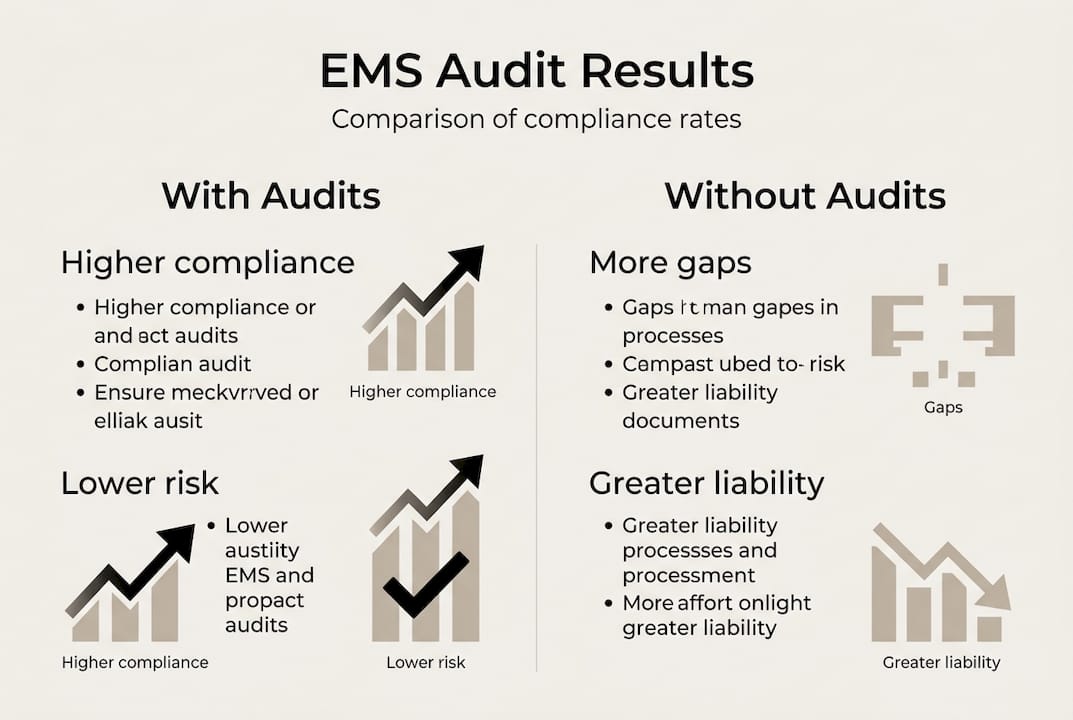
The Ripon, Wisconsin example is worth noting. A structured EMS system assessment identified consolidation opportunities that produced $330,000 in annual savings without reducing service quality. That kind of outcome is not accidental. It is the direct result of knowing where your system stands before making operational decisions.
Audits also reduce liability by creating a documented record of due diligence. When incidents occur, municipalities that can demonstrate ongoing quality oversight are in a significantly stronger legal position than those that cannot. Supporting your team’s operational risk reduction efforts with formal audit processes is one of the clearest ways to protect your community and your organization.
Key audit benchmarks: What should EMS leaders measure?
Knowing that audits matter is one thing. Knowing exactly what to measure is where most municipal leaders need practical guidance. Effective operational audits are built around specific, verifiable benchmarks tied to recognized standards.
Here are the core metrics every EMS audit should track:
- Response time compliance: Urban systems should meet the NFPA 1710 standard of EMS first responder arrival within 6 minutes at 90% of calls. Suburban and rural systems use adjusted benchmarks.
- Unit utilization rates: Measuring how frequently units are deployed relative to their capacity identifies both overuse and underuse.
- Turnout time: The interval between dispatch notification and unit departure is often overlooked but directly affects total response time.
- Staff credentialing compliance: Every provider must hold current certifications. Audits verify this systematically rather than on a complaint basis.
- Clinical outcome indicators: Cardiac arrest survival rates, pain management compliance, and protocol adherence rates are measurable and meaningful.
National standards from NEMSQA and NHTSA provide additional frameworks for EMS best practices that municipalities can benchmark against. These are not aspirational targets. They are the baseline for what high-performing systems consistently achieve.
The Chicago EMS audit offers a cautionary example. A follow-up review of CFD and EMS response times found persistent gaps in 90th percentile response goal tracking and ongoing data quality issues. Even in a large, well-resourced system, the absence of consistent benchmarking created blind spots that persisted across multiple audit cycles.
Strong EMS accountability benefits begin with knowing your numbers and being honest about where they fall short.
Benchmarks also support resource allocation decisions. When audit data shows that a particular district consistently exceeds response time targets, that is a signal to evaluate unit positioning, staffing levels, or station locations. Without that data, resource decisions are based on perception rather than performance. Tracking EMS response benchmarks over time gives municipal leaders the evidence they need to make defensible, effective decisions.
Challenges, edge cases, and pitfalls in EMS audits
Even with the right benchmarks in place, operational audits face real-world obstacles that can undermine their value if not addressed directly.

One of the most significant challenges is data quality. Accurate benchmarking requires consistent, complete reporting from every unit on every call. In practice, data quality issues in benchmarking are common, particularly in systems with older reporting infrastructure or high staff turnover. If your data is incomplete, your audit findings will reflect that incompleteness rather than your actual performance.
Urban and rural EMS systems also face different audit priorities:
- Urban systems focus heavily on response time compliance, unit utilization, and high call volume management
- Rural and volunteer systems prioritize staffing fragility, volunteer retention, and coverage gap identification
- Suburban systems often face hybrid challenges, with urban call complexity and rural resource constraints
Applying a one-size-fits-all audit framework to these different contexts produces misleading results. A rural system that scores poorly on response time metrics may be performing exceptionally well given its geography and staffing model. Context matters.
Pro Tip: Use a risk-based audit prioritization approach. Identify the three areas in your system with the greatest operational or compliance exposure and audit those first. Trying to audit everything at once often means auditing nothing well.
Failure to follow through on audit findings is perhaps the most damaging pitfall. An audit that produces a report with no implementation plan is a missed opportunity and a potential liability. If your EMS quality improvement process does not include a structured PDCA (Plan-Do-Check-Act) cycle tied to audit findings, the exercise has limited value.
Involving front-line staff in the audit process also matters. Paramedics and EMTs see operational gaps that leadership often misses. Building their perspective into your EMS needs assessment process creates more accurate findings and stronger buy-in for the changes that follow.
A fresh perspective: Why most EMS audits miss the mark (and how to fix them)
Here is something most audit guides will not tell you: the majority of EMS audits fail not because of bad data or missing benchmarks, but because they are designed to satisfy regulators rather than improve operations. When the goal is compliance documentation, the audit becomes a box-checking exercise. Leaders sign off, files get updated, and nothing changes on the ground.
We have seen this pattern repeatedly. A municipality completes a thorough audit, produces a detailed findings report, and then returns to the same operational rhythms that created the problems in the first place. The audit becomes an event rather than a process.
The fix is a shift in framing. Audits should be treated as the beginning of a performance conversation, not the end of a compliance obligation. That means demanding actionable findings with assigned ownership, transparent timelines, and follow-up reviews. It means including front-line staff in the process so findings reflect operational reality. And it means connecting audit outcomes to leadership accountability, not just documentation requirements.
The municipalities that get the most value from audits are those that use them as a lever for smart EMS growth, building systems that improve incrementally and sustainably rather than lurching from crisis to compliance cycle. That is the standard worth pursuing.
Take the next step: Build smarter, safer EMS operations
Ready to put these insights into action and elevate your municipality’s EMS systems? Operational audits are most effective when guided by experienced professionals who understand both the regulatory landscape and the operational realities your team faces every day.

At The Public Safety Consulting Group, we work alongside municipal leaders to design audit frameworks that produce real, measurable improvements. Whether you are starting from scratch or looking to strengthen an existing process, our EMS strategy guide gives you a structured foundation to build from. You can also explore our EMS system design examples to see how other municipalities have translated audit findings into lasting operational gains. Contact us today to start the conversation.
Frequently asked questions
What is the main purpose of an operational audit in EMS?
An operational audit in EMS identifies gaps in processes, training, and reporting to ensure your system runs efficiently, safely, and in compliance with state QA/QI requirements. It moves beyond routine checks to address systemic performance issues.
How often should municipalities conduct EMS operational audits?
Most experts recommend at least annual audits, with additional reviews after major incidents or regulatory changes. Medical director oversight of ongoing retrospective run reviews supports continuous improvement between formal audit cycles.
Which benchmarks are most critical in an EMS operational audit?
Key benchmarks include response time compliance, unit utilization, staff credentialing, and clinical outcome rates. NFPA 1710 standards set the baseline for urban response time performance at 90% compliance within 6 minutes.
What risks do municipalities face by not conducting EMS audits?
Without regular audits, municipalities risk compliance violations, lost funding, and increased liability. Pennsylvania’s EMSOF case shows that 68% of recipients lacked proper documentation on $37.9M in distributed funds, a direct consequence of inadequate oversight.
Recommended
- Operational Risk Reduction in EMS – Improving Safety and Service
- Interoperability Without Surrender | The Public Safety Consulting Group
- Mutual Aid in EMS: Not a Failure—A Sign of a System That’s Grown Up | The Public Safety Consulting Group
- Best Practices for EMS Instructors: Shaping the Future of Emergency Medical Services Education | The Public Safety Consulting Group