


Public safety leadership has evolved far beyond giving orders and managing tactical operations. Modern leaders must navigate constitutional complexities, foster community trust, and balance strategic judgment with operational demands. This guide explores how today’s public safety leaders drive measurable outcomes through data, culture, and accountability while addressing the challenges facing police chiefs, fire officials, and EMS directors in 2026.
Table of Contents
- The Evolving Role Of Public Safety Leaders In 2026
- Data-Driven Leadership And Community Engagement As Pillars Of Effectiveness
- Real-World Outcomes: Case Studies On Leadership Impact
- Essential Frameworks And Best Practices For Public Safety Leadership In 2026
- Enhance Your Public Safety Leadership With Expert Guidance
Key takeaways
| Point | Details |
|---|---|
| Modern leadership integrates strategic, community, and operational roles | Public safety leaders must balance tactical expertise with constitutional fluency and community engagement |
| Building community trust is a leadership imperative | Strong police-community ties increase crime reporting willingness by 10-15% |
| Data-driven decision-making reduces crime measurably | Predictive policing models show 15-25% improvement in preventing crime hotspots |
| Positive organizational culture drives outcomes | Leadership focused on effort and authenticity led to 40% crime reduction in Weatherford, Texas |
| Standardized frameworks improve emergency response | NIMS adoption enhances interagency coordination and operational efficiency during critical incidents |
The evolving role of public safety leaders in 2026
The modern police chief operates at a complex intersection of law, politics, and ethics that barely existed a generation ago. The role has evolved beyond tactical command to include strategic legitimacy, constitutional fluency, and community trust-building as core competencies. Fire chiefs and EMS directors face similar pressures as public expectations expand beyond emergency response to include prevention, equity, and transparency.
This shift reflects fundamental changes in how communities evaluate their public safety leadership. Chiefs are increasingly judged on external legitimacy when navigating politically charged incidents, requiring skills that extend far beyond traditional command structures. Cultural competency has moved from optional training to a central leadership function that directly impacts operational effectiveness.
Effective public safety leaders in 2026 must master several distinct competencies:
- Constitutional knowledge that guides decision-making during high-pressure incidents
- Strategic communication skills to maintain public confidence across diverse stakeholder groups
- Political navigation abilities that protect agency independence while respecting democratic oversight
- Community engagement expertise that builds lasting trust through authentic partnership
- Operational excellence that delivers measurable safety improvements
These expanded responsibilities create significant challenges for leaders promoted primarily for tactical expertise. The traditional pathway from patrol officer to chief or from paramedic to EMS director no longer guarantees the diverse skill set required for modern leadership success. Organizations must identify and develop leaders who combine operational credibility with strategic vision.
“Leadership is no longer just about managing incidents. It’s about shaping the culture, building community partnerships, and making strategic decisions that impact safety outcomes for years to come.”
This evolution requires agencies to rethink recruitment, training, and succession planning. Identifying future leaders means looking beyond tenure and tactical skills to assess candidates’ capacity for strategic thinking, emotional intelligence, and adaptive leadership. Municipalities seeking to strengthen their public safety strategy must invest in leadership development programs that address these modern demands.
Data-driven leadership and community engagement as pillars of effectiveness
The most effective public safety leaders use crime data and analytics to drive strategic decisions while maintaining strong community partnerships. Departments using predictive policing models show 15-25% improvement in preventing crime hotspots by deploying resources based on pattern analysis rather than reactive dispatch. This data-driven approach allows leaders to demonstrate accountability and measure program effectiveness objectively.

Community engagement amplifies these analytical capabilities by providing context that raw data cannot capture. Communities with strong police ties report 10-15% more willingness to report crime, creating a virtuous cycle where better information leads to more effective interventions. Leaders who balance quantitative metrics with qualitative community feedback make more informed decisions about resource allocation and policy priorities.
The impact of positive organizational culture on safety outcomes demonstrates how internal leadership practices translate to external results. Chief Lance Arnold’s leadership in Weatherford, Texas led to a 40% reduction in overall crime and 60% drop in burglaries by fostering a culture built on effort, authenticity, intentionality, and ownership. These results show how leadership philosophy directly influences operational performance.
| Leadership Approach | Crime Reduction | Community Trust Impact |
|---|---|---|
| Data-driven predictive policing | 15-25% hotspot prevention | Moderate (transparency builds confidence) |
| Strong community partnerships | 10-15% increased reporting | High (direct relationship building) |
| Positive organizational culture | 40% overall crime reduction (case study) | High (officer behavior reflects culture) |
| Combined approach | Maximum potential impact | Highest (synergistic effects) |
Implementing these strategies requires leaders to overcome common barriers:
- Resistance to change within established organizational cultures
- Limited technology infrastructure for data collection and analysis
- Budget constraints that restrict community engagement programs
- Officer skepticism about new accountability measures
- Political pressures that prioritize short-term responses over strategic planning
Pro Tip: Start small with data initiatives by tracking one or two key metrics consistently rather than attempting comprehensive analytics immediately. Build credibility through early wins that demonstrate value to skeptical stakeholders.
Successful leaders frame accountability as a strength rather than a concession to critics. They use data to celebrate officer achievements, identify training needs, and allocate resources more effectively. This approach transforms metrics from punitive tools to strategic assets that improve public safety risk reduction outcomes.
The integration of community voice with analytical rigor creates a comprehensive leadership model. Officers feel supported by leaders who use data to defend effective practices and advocate for necessary resources. Community members see tangible evidence that their concerns drive operational decisions. This dual accountability strengthens both internal culture and external legitimacy.
Leaders must also recognize that data quality depends on honest reporting and cultural safety. Officers in punitive environments underreport incidents or manipulate statistics to avoid consequences. Building a culture where accountability enhances excellence rather than punishing mistakes creates more reliable data and better outcomes.
Real-world outcomes: case studies on leadership impact
Examining specific jurisdictions reveals how leadership strategies translate to measurable safety improvements or persistent challenges. Baltimore’s experience illustrates the complexity of urban public safety leadership. The city’s homicide rate remained among the top five in the United States for over two decades, with a 62% increase in gun violence following Freddie Gray’s death in 2015. This case demonstrates how systemic factors, historical context, and community relations intersect with leadership effectiveness.
Baltimore’s challenges highlight several critical lessons for public safety leaders:
- External pressures can overwhelm internal reforms without sustained community support
- Data systems like CompStat only improve outcomes when implemented authentically rather than for political theater
- Leadership transitions during crisis periods disrupt strategic initiatives and erode institutional knowledge
- Addressing root causes requires collaboration beyond law enforcement agencies
Contrasting Baltimore’s struggles, Miami’s recent trajectory shows what effective leadership combined with strategic focus can achieve. Miami experienced a 42.6% drop in homicides, 30.1% drop in robberies, and declines in other violent crimes since 2021 through improved leadership strategies emphasizing both enforcement and community fairness. This turnaround demonstrates that even cities with significant crime challenges can achieve dramatic improvements under the right leadership.
| City | Leadership Approach | Crime Outcome | Key Success Factor |
|---|---|---|---|
| Baltimore | Data-driven (CompStat) with political pressure | 62% increase in gun violence post-crisis | System overwhelmed by external factors |
| Miami | Balanced enforcement with community fairness | 42.6% homicide reduction since 2021 | Sustained strategic focus |
| Weatherford, TX | Positive culture emphasis | 40% overall crime reduction | Internal culture transformation |
These contrasting outcomes reveal that leadership impact depends on matching strategies to local context. Miami’s success came from leaders who maintained strategic priorities despite political pressures and invested in both officer capabilities and community relationships. The consistency of leadership vision allowed initiatives to mature and produce measurable results.
“The difference between cities that improve and those that struggle often comes down to leadership stability, authentic community engagement, and the courage to maintain strategic focus during political turbulence.”
Public safety leaders can extract several actionable insights from these cases:
- Implement data systems with genuine commitment to using insights, not just collecting statistics
- Build community partnerships before crises occur to create resilience during difficult periods
- Maintain strategic priorities across leadership transitions through documented plans and institutional culture
- Address officer wellness and organizational health as prerequisites for external effectiveness
- Communicate transparently about both successes and challenges to build lasting public trust
The Baltimore and Miami comparison also illustrates the importance of regional context in evaluating leadership effectiveness. Cities facing deep structural challenges require longer timeframes and more comprehensive strategies than jurisdictions with stronger baseline conditions. Leaders must set realistic expectations while maintaining urgency for improvement.
Agencies looking to replicate Miami’s success should analyze their public safety trends to identify which strategies align with local challenges. Cookie-cutter approaches imported from other jurisdictions often fail because they ignore unique community dynamics, resource constraints, and political environments.
Essential frameworks and best practices for public safety leadership in 2026
Adopting proven frameworks helps leaders navigate complexity and maintain consistency during crisis periods. The National Incident Management System provides a standardized approach to incident management that improves interagency coordination and operational efficiency during emergencies. NIMS adoption ensures that agencies speak a common language when responding to major incidents that require multi-jurisdictional cooperation.
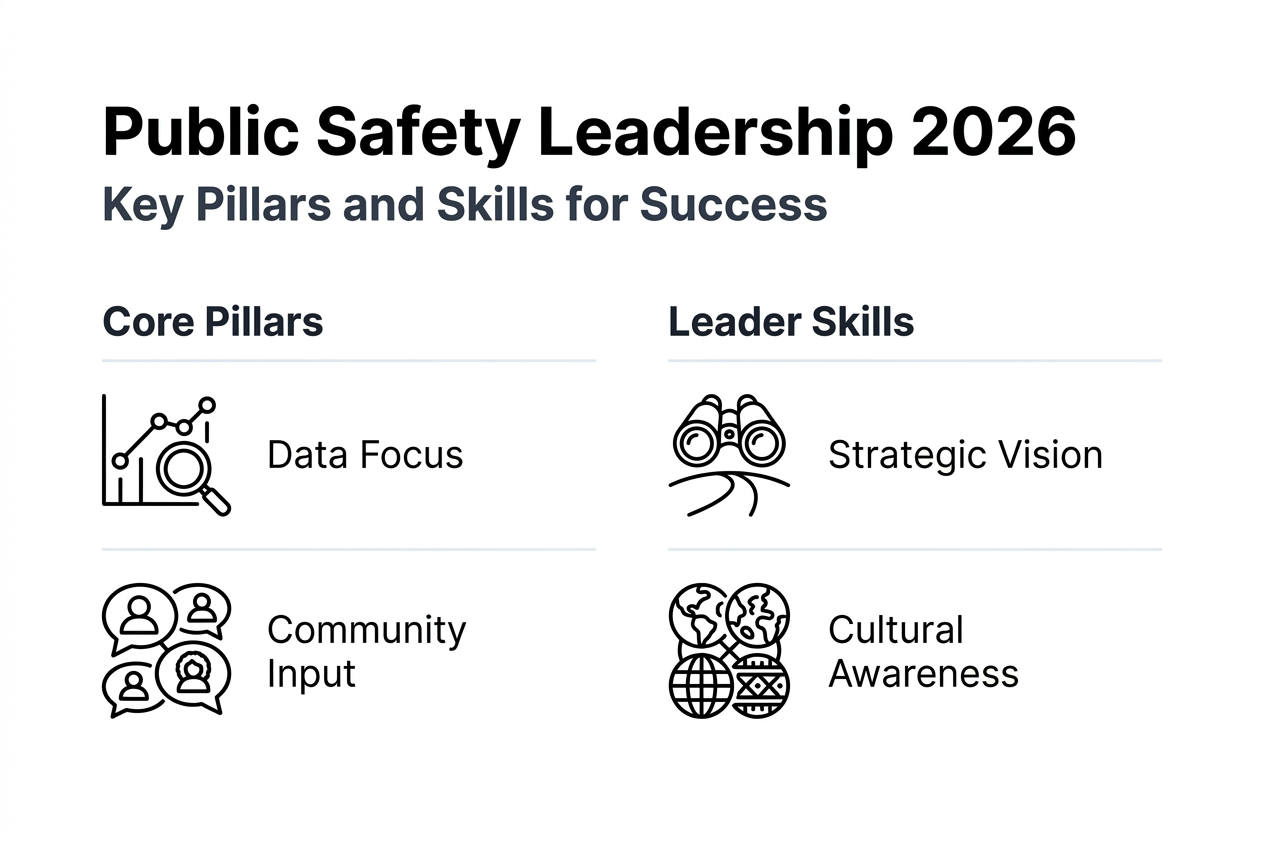
Beyond operational frameworks, cultivating the right organizational culture distinguishes exceptional leaders from competent managers. Focusing on officer wellness reduces burnout and improves organizational health by recognizing that sustainable performance requires supporting personnel’s physical and mental wellbeing. Leaders who prioritize wellness create environments where officers can perform at their best over entire careers rather than burning out after a few years.
Effective public safety leadership in 2026 integrates these essential practices:
- Standardize incident command using NIMS to enable seamless coordination during complex emergencies
- Build organizational culture on effort, authenticity, intentionality, and ownership rather than fear or compliance
- Invest in officer wellness programs that address trauma, stress, and work-life balance proactively
- Frame accountability as a tool for excellence that identifies training needs and celebrates achievements
- Engage in continuous strategic planning that anticipates challenges and positions agencies to respond effectively
Pro Tip: Schedule quarterly leadership team sessions dedicated solely to strategic thinking without operational distractions. Use this protected time to evaluate progress on long-term goals and adjust tactics based on emerging trends.
Integrating accountability throughout operations strengthens rather than weakens organizational performance. Leaders who view accountability as a competitive advantage use it to identify high performers, document best practices, and make evidence-based resource decisions. This approach transforms accountability from a defensive posture into a strategic asset.
Strategic planning processes help agencies prepare for predictable challenges while building capacity to adapt to unexpected developments. Leaders who invest in strategic planning for public safety readiness position their organizations to respond effectively to evolving threats, demographic shifts, and technological changes. These plans provide continuity across leadership transitions and align daily operations with long-term objectives.
The most successful leaders also recognize that building their own capabilities requires ongoing development. Attending conferences, participating in peer networks, and seeking mentorship from experienced chiefs creates opportunities to learn from others’ successes and failures. Leadership development should not end with promotion but accelerate as responsibilities expand.
Agencies committed to leadership excellence should establish formal succession planning and development programs. Identifying potential leaders early and providing them with diverse experiences, training opportunities, and mentorship prepares the next generation to handle modern public safety challenges. Resources focused on how to build public safety leadership capacity offer frameworks for creating these developmental pathways.
Enhance your public safety leadership with expert guidance
Navigating the complex demands of modern public safety leadership requires expertise, strategic vision, and proven frameworks that translate best practices to your specific context. The Public Safety Consulting Group specializes in helping agencies strengthen leadership capabilities, implement data-driven strategies, and build organizational cultures that deliver measurable safety improvements.

Our consulting services support public safety leaders through strategic planning, risk reduction initiatives, and leadership development programs tailored to your agency’s unique challenges. Whether you’re refining your strategic planning approach, implementing risk reduction strategies, or developing your leadership team’s capabilities, we provide the expertise and support to elevate your impact. Explore how our specialized resources can help you build the leadership capacity your community deserves by visiting our leadership development resources.
Frequently asked questions
What is public safety leadership?
Public safety leadership encompasses the strategic, operational, and community-focused responsibilities of guiding law enforcement, fire, and EMS agencies. Modern leaders must balance tactical expertise with constitutional knowledge, community trust-building, and data-driven decision-making to achieve measurable safety outcomes.
How has public safety leadership changed in recent years?
Leadership has evolved from primarily tactical command to include strategic legitimacy, political navigation, and cultural competency as core functions. Chiefs now face greater scrutiny on community relations, constitutional compliance, and their ability to maintain public confidence during controversial incidents.
What skills do effective public safety leaders need in 2026?
Effective leaders combine operational credibility with strategic vision, constitutional fluency, community engagement expertise, and data analysis capabilities. They must navigate political pressures while maintaining agency independence and build organizational cultures that support both officer wellness and accountability.
How does community engagement improve public safety outcomes?
Strong police-community relationships increase crime reporting willingness by 10-15%, providing better intelligence for strategic interventions. Community trust also enhances cooperation during investigations, reduces tensions during incidents, and creates collaborative problem-solving opportunities that address root causes of crime.
What role does data play in modern public safety leadership?
Data enables leaders to make evidence-based decisions about resource allocation, measure program effectiveness objectively, and demonstrate accountability to stakeholders. Predictive policing models improve crime prevention by 15-25% in hotspot areas, while performance metrics help identify training needs and celebrate officer achievements.