



Ambulance HCPCS codes live inside the A0021–A0999 range, but seven codes do the real work: base-rate codes A0426, A0427, A0428, A0429, A0433, and A0434, plus mileage codes A0425, A0435, and A0436. Payment hinges less on knowing the range and more on one discipline: picking the correct base rate (BLS versus ALS versus SCT), pairing it with the right origin/destination modifier, and documenting medical necessity at the moment of pickup. Get that sequence wrong and the mileage math never matters.
TL;DR:
- Accurate base-rate code selection depends on whether the transport was emergency or non-emergency and the level of care provided during the trip.
- Mileage coding requires precise formatting, with specific rounding rules and separate reporting for multi-leg transports to prevent rejection.
- Proper documentation includes patient condition, interventions, origin and destination types, crew credentials, and correct modifiers, especially the attending physician NPI when needed.
- Medicare coverage is limited to transports meeting strict medical necessity criteria, excluding convenience or non-essential transfers, with detailed rules for air and specialty care transports.
- Building thorough PCR templates and crew training for specific interventions significantly reduces claim denials more than focusing solely on modifier knowledge.
Table of Contents
- What Are Ambulance HCPCS Codes, and Which Ones Actually Drive Payment?
- How Do You Choose the Right Base-Rate Code for Each Transport?
- Getting Mileage, Units, and Rounding Right
- Documentation, Modifiers, and the Fields Medicare Checks First
- What We See in the Field: Denial Triggers and How to Fix Them
- What Actually Counts as Medical Necessity for Ambulance Transport
- The Three Categories of Ambulance Service Medicare Actually Covers
- Where Medicare Coverage Stops: Limitations and Exclusions
- How Ambulance Claims Move From Submission to Payment
- How to Appeal an Ambulance HCPCS Denial
- Primary Sources Worth Bookmarking
- Turning Correct Coding Into Consistent Reimbursement
- The Real Lesson Buried in the Fee Schedule
- Sources
What Are Ambulance HCPCS Codes, and Which Ones Actually Drive Payment?
Every ambulance claim submitted to Medicare rests on a small set of codes drawn from the broader Healthcare Common Procedure Coding System. The Centers for Medicare & Medicaid Services publishes these rates through the Ambulance Fee Schedule Public Use Files, which assign a relative value unit to each base-rate code and update annually. Coders who treat this schedule as background reading rather than a working document tend to see it in their denial reports later.
The table below organizes the codes coders reference most often, along with the role each plays on a claim.
| HCPCS Code | Service Level | Role on the Claim |
|---|---|---|
| A0426 | ALS Level 1, non-emergency | Base rate; requires attending physician NPI |
| A0427 | ALS Level 1, emergency | Base rate; no attending physician NPI required |
| A0428 | BLS, non-emergency | Base rate; requires attending physician NPI |
| A0429 | BLS, emergency | Base rate; no attending physician NPI required |
| A0430 | Fixed-wing air ambulance | Base rate for air transport |
| A0431 | Rotary-wing air ambulance | Base rate for air transport |
| A0432 | Volunteer ambulance company, ALS | Base rate; specific to qualifying volunteer services |
| A0433 | ALS Level 2 | Base rate for higher-acuity ALS interventions |
| A0434 | Specialty Care Transport (SCT) | Base rate for critical-care level transport |
| A0425 | Ground mileage | Loaded-mile reporting, fractional units |
| A0435 | Fixed-wing air mileage | Loaded-mile reporting for air transport |
| A0436 | Rotary-wing air mileage | Loaded-mile reporting for air transport |
Two things jump out once you sit with this list. First, whether a transport is emergency or non-emergency doesn’t just change the modifier, it changes the code itself, since A0426/A0428 and A0427/A0429 are entirely separate codes rather than the same code with a suffix. Second, rural providers should check whether their pickup ZIP code qualifies for the 22.6% super-rural bonus CMS applies to designated low-population areas, since it can meaningfully change what a correctly coded claim actually pays.
How Do You Choose the Right Base-Rate Code for Each Transport?
Start with one question: was this transport an emergency response, or a scheduled non-emergency move? That single fork determines whether you’re even looking at the right code family before you think about acuity level.
From there, the decision tree runs in three steps:
- Step 1: Emergency or non-emergency? An emergency response to a 911 call points toward A0427, A0429, or A0433. A scheduled transfer, discharge, or facility-to-facility move points toward A0426 or A0428, and pulls in the attending physician NPI requirement.
- Step 2: What level of care did the crew actually deliver? BLS covers basic monitoring and non-invasive care. ALS Level 1 requires an ALS assessment or at least one ALS intervention, things like IV therapy, cardiac monitoring, or medication administration. ALS Level 2 (A0433) requires multiple ALS interventions or specific higher-acuity procedures.
- Step 3: Does the acuity justify SCT or air transport? Specialty Care Transport (A0434) applies when a patient needs care beyond the scope of the paramedic, such as a nurse or specialist managing ventilators, drips, or advanced monitoring during interfacility transfer. Air ambulance codes (A0430, A0431) apply only when ground transport would endanger the patient or the distance and timing make air transport medically necessary.
A scene-to-hospital cardiac call with a 12-lead and IV push maps to A0427. A dialysis leg with no ALS intervention typically maps to A0428. A ventilator-dependent interfacility transfer with a critical care nurse aboard maps to A0434, not A0433, because the intervention level exceeds standard paramedic scope. The AMBCI coding guide makes the point plainly: base-rate selection is the single most fragile part of an ambulance claim, and the narrative has to tie directly to the interventions performed, not just the diagnosis on the run sheet.
Getting Mileage, Units, and Rounding Right
Loaded mileage gets its own codes because it’s billed separately from the base rate: A0425 for ground transport, A0435 for fixed-wing air, and A0436 for rotary-wing air. You report these only for miles the patient was actually aboard, not miles the unit traveled empty to reach the scene.
Three rounding rules cause more rejections than any clinical documentation issue:
- Most trips report mileage to one decimal place (for example, 8.3 miles).
- Trips of 100 miles or more round to the nearest whole mile.
- Trips under one mile still need a leading zero (0.9, not .9) or the electronic claim will reject on formatting alone.
Pro Tip: Run a formatting check before submission rather than after a rejection. According to Novitas Solutions’ ambulance billing guide, a large share of mileage rejections trace back to missing leading zeros or wrong decimal precision, not clinical justification.
For multi-leg transports, report mileage separately for each leg and align the base code to each leg’s own documentation. Combining legs into a single mileage entry without leg-by-leg support is exactly the pattern that invites a contractor edit. Our own mileage billing guide walks through the formatting checks that catch this before a claim ever leaves the building.
Documentation, Modifiers, and the Fields Medicare Checks First
Medicare contractors read the trip sheet before they read the code. That order matters because the code only holds up if the paperwork behind it does too.
A defensible run sheet includes:
- Patient condition and vitals at the point of pickup, not just on arrival at the destination
- Every intervention performed, with times, to support the ALS or SCT level billed
- Origin and destination facility types, which drive the required modifier pair
- Crew configuration and credentials for the level of care billed
Origin/destination modifiers are two-letter codes (like R for residence, H for hospital, N for skilled nursing facility) that combine to show where the patient started and ended up. Get the pairing backward and the claim can reject even when the base code is perfect. Institutional claims also carry indicators like QM and QN to show whether the ambulance provider owns the vehicle or contracts it, and scenario-specific modifiers like QL flag a patient who died before reaching the destination.
The NPI rule is one of the most commonly missed details in the entire code set: non-emergency codes A0426 and A0428 require an attending physician NPI on the claim, while emergency codes A0427, A0429, A0430, A0431, A0432, A0433, and A0434 do not, according to Noridian’s hospital-based ambulance billing guide. Our breakdown of the physician certification statement walks through exactly when that PCS is required and how to attach it correctly.
What We See in the Field: Denial Triggers and How to Fix Them
We’ve spent enough time inside agency billing workflows to know the pattern that shows up over and over: the crew delivers excellent, high-acuity care, and the claim still gets downgraded because the narrative doesn’t say so in language the payer recognizes.
The fixes that actually move denial rates:
- Lock your PCR template to the billed level. If your protocol allows ALS2 billing, your PCR template should prompt crews for the specific interventions that justify it, not just a general narrative box.
- Watch the 35-mile Critical Access Hospital rule. Transports to or from a CAH may qualify for cost-based payment instead of standard AFS rates, but only when the claim carries the B2 condition code. Miss that code and the claim processes at the standard rate, quietly underpaying the agency.
- Treat A0999 as a last resort, not a shortcut. The unlisted ambulance service code should appear only when no other code fits the service delivered, and only with a detailed narrative explaining why. Overusing it invites scrutiny rather than smoother payment.
- Document air transport justification up front. Air ambulance claims need documentation showing why ground transport wasn’t safe or timely enough, not just that air transport was available.
Pro Tip: Build a pre-bill cross check into your workflow: confirm the base code matches the narrative, confirm the modifier pair matches the origin and destination, and verify mileage formatting before the claim goes out the door. That single checkpoint catches the majority of the errors that otherwise surface as denials weeks later.
What Actually Counts as Medical Necessity for Ambulance Transport
Medical necessity for ambulance transport isn’t about whether the patient needed to get to a hospital. It’s about whether the patient’s condition required transport specifically by ambulance, with the level of medical monitoring and intervention only an ambulance crew can provide, rather than by car, wheelchair van, or other means.
That distinction has to show up in the documentation, not just in the coder’s understanding of the case. A run sheet that says “patient transported to ED” proves nothing.
For non-emergency transports, this documentation burden often falls to the ordering physician through the Physician Certification Statement, which attests that the patient’s condition meets Medicare’s definition. For emergency responses, the necessity is typically self-evident from the nature of the call and the crew’s own assessment, which is part of why emergency codes skip the attending NPI requirement that non-emergency codes carry.
Coders who write the narrative themselves, rather than relying on the field crew’s shorthand, consistently produce cleaner claims. The goal isn’t to embellish what happened. It’s to translate what happened into the specific clinical language a claims examiner is trained to look for.
The Three Categories of Ambulance Service Medicare Actually Covers
Medicare organizes ambulance coverage into three broad categories, and knowing which one applies determines which code family you’re working from before you even think about acuity level.
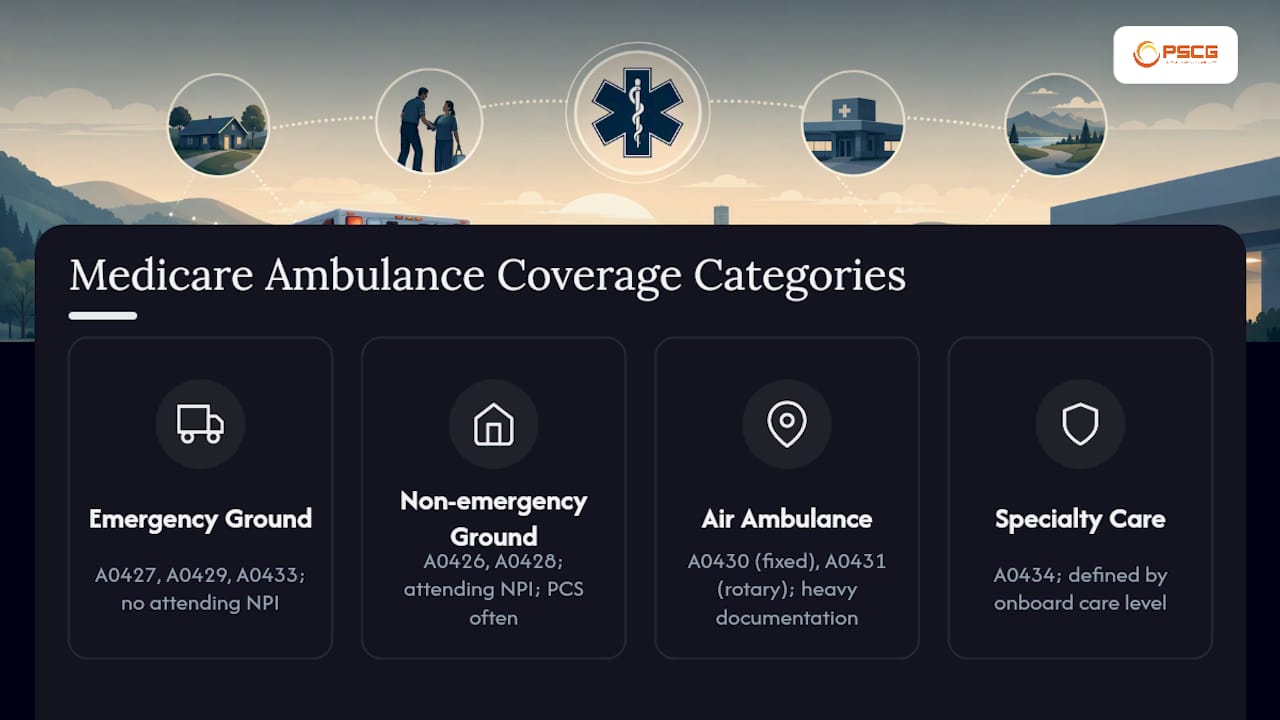
Emergency ground transport covers 911 responses and other urgent scene calls, coded under A0427 (ALS1), A0429 (BLS), or A0433 (ALS2) depending on the interventions delivered. These claims skip the attending physician NPI requirement because the emergent nature of the call substitutes for that certification.
Non-emergency ground transport covers scheduled transfers, discharges to skilled nursing facilities, and recurring trips like dialysis, coded under A0426 (ALS1) or A0428 (BLS). These require the attending physician’s NPI and, in many cases, a Physician Certification Statement establishing why the patient’s condition requires ambulance-level transport rather than a lower-cost alternative.
Air ambulance transport covers both fixed-wing (A0430) and rotary-wing (A0431) services, reserved for cases where ground transport would put the patient at greater risk or where distance and time make ground transport medically inappropriate. Air transport claims carry the heaviest documentation burden of the three categories, since payers scrutinize whether ground transport was genuinely ruled out.
Specialty Care Transport (A0434) sits alongside these categories rather than inside one of them, since it’s defined by the level of care aboard, not by whether the call originated as emergency or scheduled.
Where Medicare Coverage Stops: Limitations and Exclusions
Medicare’s ambulance benefit is narrower than most new billers expect. Coverage generally applies to transport to the nearest appropriate facility capable of treating the patient’s condition, not necessarily the facility the patient or family prefers.
Transport for convenience rather than medical necessity is excluded outright. A patient who could safely travel by wheelchair van or personal vehicle doesn’t qualify for ambulance-level coverage simply because an ambulance was requested. Coverage also generally excludes transport when a closer appropriate facility was bypassed for a farther one, unless the documentation supports why the closer facility couldn’t meet the patient’s needs.
Non-emergency coverage carries the tightest scrutiny. Medicare expects a Physician Certification Statement for scheduled, repetitive transports like dialysis, and claims lacking that certification, or carrying a certification that doesn’t match the clinical picture, are routine denial targets. Origin and destination also matter: transport between two locations that don’t meet Medicare’s coverage definitions, such as a transport that both begins and ends at a non-covered location, won’t be reimbursed regardless of how well it’s coded.
Coverage rules and exclusions sit in 42 CFR Part 410, Subpart B, which remains the authoritative reference when a coverage question isn’t resolved by the fee schedule alone. Commercial payers frequently mirror these Medicare exclusions but aren’t bound by them, so always verify plan-specific policy for non-Medicare claims.
How Ambulance Claims Move From Submission to Payment
Most ambulance claims submit electronically through the 837 professional format, or on paper CMS-1500 forms for agencies still working outside electronic systems. Once submitted, Medicare Administrative Contractors like Novitas or Noridian run the claim through automated edits before a human ever reviews it, and this is where formatting errors, mismatched modifiers, and incomplete mileage fields get caught first.
Clean claims typically process within the standard Medicare timeline, with payment following shortly after acceptance. Claims flagged by contractor edits get routed for additional review, which adds days or weeks depending on what triggered the flag and whether additional documentation is requested. A claim asking for medical records or a corrected PCS can sit in review considerably longer than one that clears edits on the first pass.
The practical lesson for agencies: the fastest path to payment isn’t found in expediting anything after submission, it’s in building a pre-submission process that catches base-code mismatches, modifier pairing errors, and mileage formatting issues before the claim ever reaches the contractor’s system. Every hour spent on that front-end check saves considerably more time on the back end chasing a denial.
How to Appeal an Ambulance HCPCS Denial
Medicare’s appeals process for ambulance claims follows the same five-level structure as other Part B denials, but the evidence you need to win looks different for ambulance coding specifically.
The first level, redetermination, is handled by the same Medicare Administrative Contractor that processed the original claim. This is where most ambulance coding denials should be resolved, because the fix is usually straightforward: submit the redetermination request with the corrected or clarified documentation that shows the base code matches the level of care actually delivered. If the original denial cited a missing PCS or an NPI mismatch, attach the corrected form rather than simply resubmitting the same claim.
If redetermination doesn’t resolve it, the claim moves to reconsideration by a Qualified Independent Contractor, then potentially to an Administrative Law Judge hearing for claims meeting the dollar threshold. Few ambulance coding disputes reach that level, since most trace back to a documentation gap that’s fixable at redetermination.
The strongest appeals share one trait: they tie the narrative directly to the interventions performed, matching the standard the AMBCI coding guide recommends using at the point of original submission. An appeal is far more persuasive when it simply clarifies documentation that already existed than when it introduces new clinical detail that wasn’t in the original run sheet.
Primary Sources Worth Bookmarking
Coders who verify against primary sources catch errors that secondary guides miss.
- CMS Ambulance Fee Schedule Public Use Files, for current base rates, RVU tables, and the Ambulance Fee Schedule resources covering medical conditions and ICD-10 crosswalks.
- Novitas and Noridian contractor guides, since national AFS rules still get applied through contractor-specific formatting and submission edits.
- ResDAC’s ambulance identification guide, for anyone working with Medicare claims files at the dataset level.
- PSCG’s mileage and documentation templates, built from field practice with agencies working through exactly these denial patterns.
Turning Correct Coding Into Consistent Reimbursement
Getting ambulance HCPCS codes right on paper is only half the job. The agencies that actually see fewer denials are the ones that build the correct base-rate logic, modifier pairing, and documentation standards into their operational workflow, not just their coding reference sheet. That’s where reimbursement optimization stops being a coding exercise and becomes an organizational one, touching PCR design, crew training, and how billing staff and field providers communicate before a claim ever gets coded.
Thepscgroup works with municipal EMS agencies, fire departments, and private ambulance companies to close exactly this gap, pairing CMS fee-schedule accuracy with the kind of denial-prevention workflow that holds up under contractor scrutiny. If your agency is seeing base-rate downgrades, mileage rejections, or NPI mismatches on a recurring basis, our reimbursement consulting work is built to find the operational fix, not just flag the symptom. Visit Thepscgroup to learn more about how we support agencies working through these exact billing challenges.
The Real Lesson Buried in the Fee Schedule
The conventional advice on ambulance coding treats it like a lookup problem: find the code, apply the modifier, submit the claim. That framing misses what actually determines whether an agency gets paid consistently, which is whether the documentation habits of field crews and the coding habits of billing staff are speaking the same clinical language before a claim ever gets typed.
What’s underrated in most coding guidance is how much of the denial problem is preventable weeks before submission, back at the PCR template and the crew training that shapes what gets written down at pickup. What’s overrated is the idea that better modifier knowledge alone fixes denial rates. Modifiers matter, but they’re the last mile of a process that succeeds or fails at the first mile: the narrative written at the patient’s side.
If you take one thing from this reference, make it this: audit your PCR template before you audit your denial log. A template that prompts crews for the specific interventions that justify ALS or SCT billing will do more for your reimbursement rate than any amount of downstream coding vigilance. The fee schedule rewards precision that starts in the field, not just precision that ends in the billing office.
— Mike
This article is general information, not a substitute for advice from a qualified financial advisor. Consult a qualified financial professional about your own circumstances before acting on anything here.
Sources
- Ambulance Fee Schedule Public Use Files | CMS
- Ambulance Billing Guide (Novitas Solutions)
- Hospital-Based Ambulance Billing Guide – Noridian
- Guide to Ambulance & Emergency Transport Coding — AMBCI