


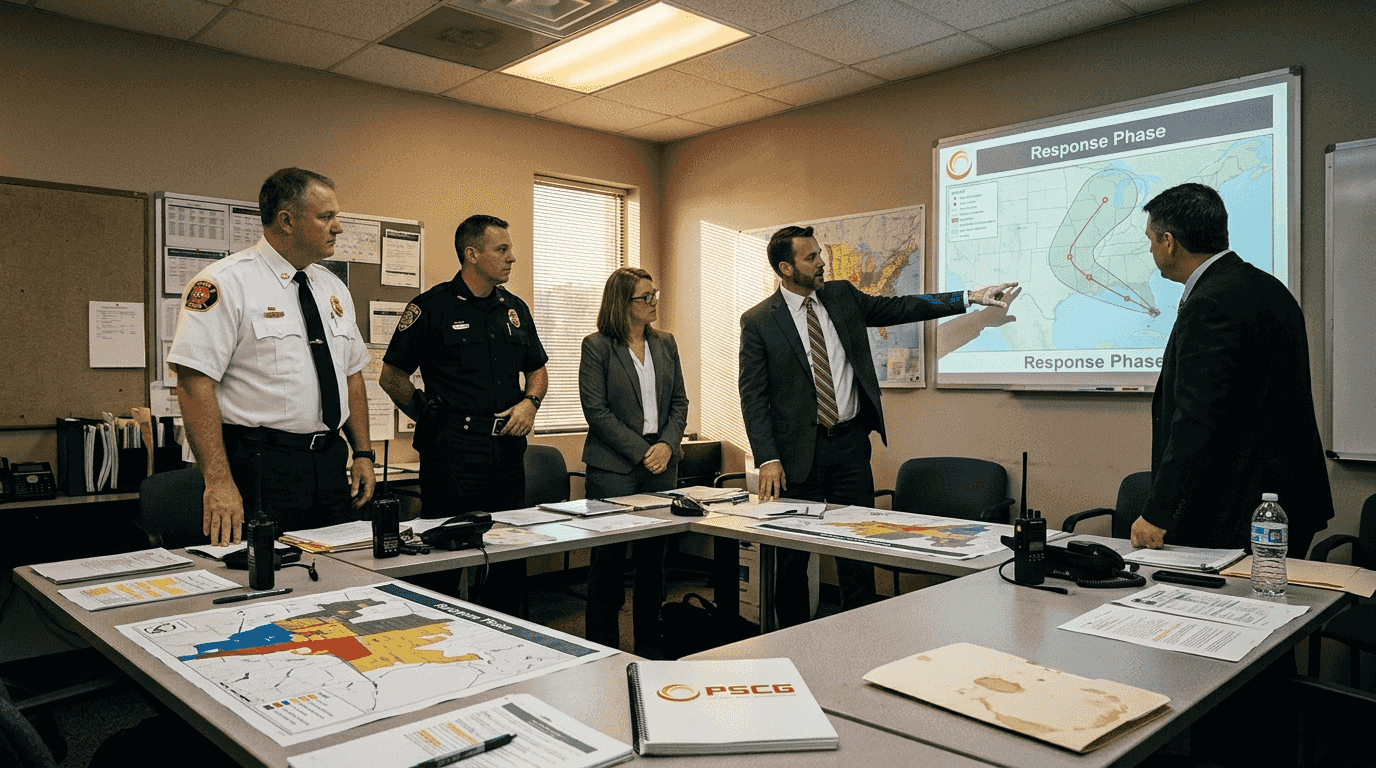
Many public safety officials believe emergency management is only about crisis response, yet this narrow view overlooks the comprehensive planning, mitigation, and recovery coordination that define modern emergency management. Federal frameworks like the National Mitigation Framework, National Response Framework, and National Disaster Recovery Framework establish a whole community approach requiring collaboration across government, private sector, and individual stakeholders. This guide clarifies foundational emergency management concepts, explains how federal frameworks integrate with local operations, and provides practical approaches for building resilient communities in 2026.
Table of Contents
- Understanding Emergency Management Frameworks And Risk-Based Approaches
- Community-Based Emergency Planning And The Role Of Whole Community Engagement
- Incident Management Systems And Federal Coordination Mechanisms
- Integrating Recovery Planning Into Emergency Management And Ongoing Preparedness
- Explore Expert Public Safety Solutions And Strategic Planning Services
- Frequently Asked Questions
Key takeaways
| Point | Details |
|---|---|
| Whole community effort | Emergency management requires coordinated action from individuals, governments, nonprofits, and private sectors to build resilience effectively. |
| Federal frameworks define roles | National Mitigation, Response, and Recovery Frameworks establish standardized coordination structures and guide risk-based decision making. |
| Risk-based planning is essential | Prioritizing mitigation efforts based on community-specific risk assessments ensures efficient resource allocation and targeted protection. |
| Emergency Support Functions organize aid | ESFs coordinate federal assistance across functional areas like transportation, logistics, and public health during incidents. |
| Recovery starts during response | Initiating recovery planning while managing active incidents ensures seamless transitions and addresses long-term community impacts early. |
Understanding emergency management frameworks and risk-based approaches
Emergency management is coordinated risk management spanning preparedness, response, mitigation, and recovery phases. This systematic approach protects communities by reducing vulnerabilities before disasters strike, managing incidents effectively when they occur, and rebuilding stronger afterward. The discipline requires understanding how federal frameworks guide local action while adapting to unique community risks and resources.
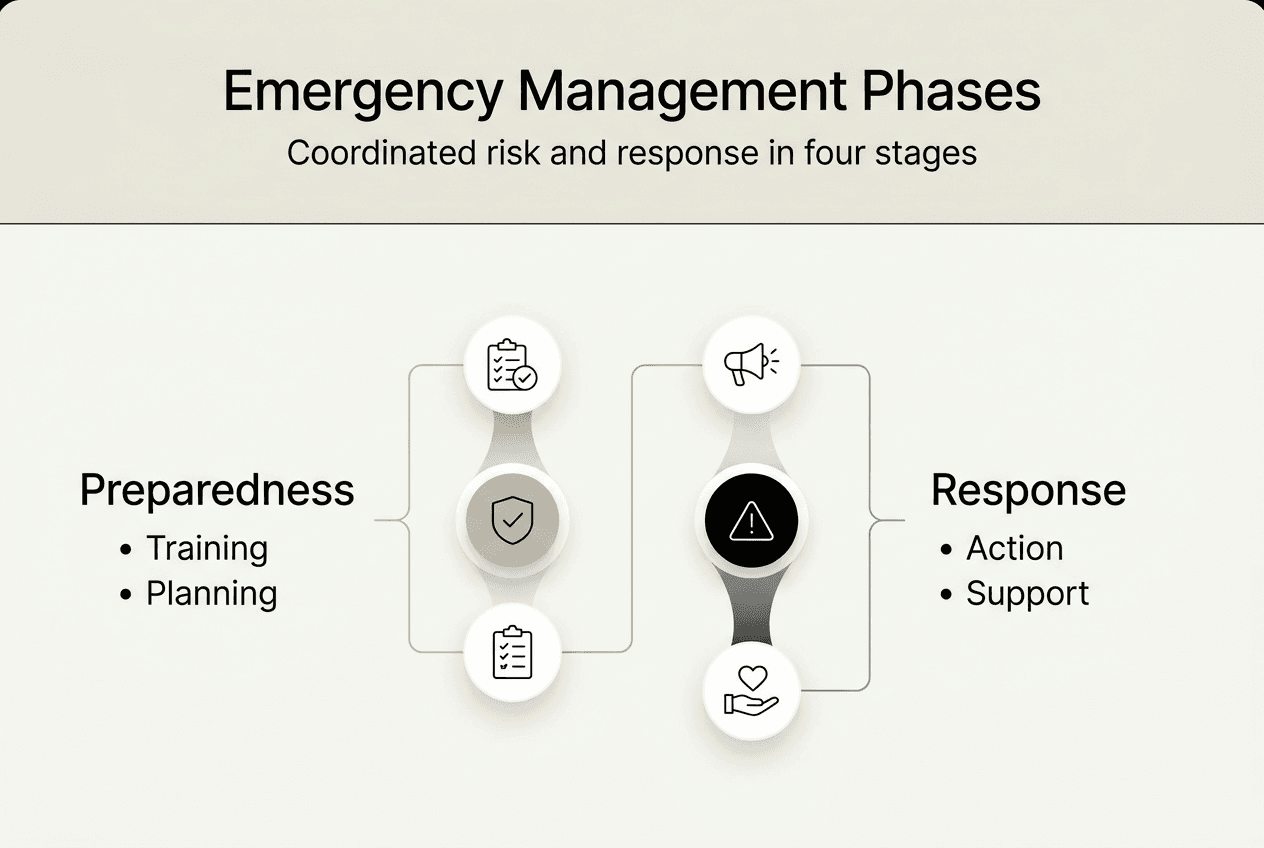
The National Mitigation Framework establishes a common platform for coordinating how the nation manages risk through mitigation capabilities. This framework emphasizes whole community engagement where every stakeholder from individuals to federal agencies contributes to risk reduction. By focusing on prevention and long-term vulnerability reduction, communities can avoid costly disaster impacts and protect lives more effectively than reactive approaches alone.
The National Response Framework guides how the nation responds to all types of disasters and emergencies through scalable, flexible, and adaptable operational structures. This framework enables jurisdictions of any size to coordinate with federal partners using standardized processes and terminology. Response operations scale from local incidents managed entirely by municipal resources to catastrophic events requiring extensive federal support and multi-state coordination.
The National Disaster Recovery Framework provides a consistent, nationwide approach for coordinating recovery efforts across government levels and private sector partners. Long-term recovery demands sustained commitment and resources extending months or years beyond initial response operations. This framework organizes recovery around six Recovery Support Functions addressing housing, economic recovery, infrastructure systems, natural and cultural resources, community planning, and health and social services.
Risk-based decision making serves as the central principle guiding effective mitigation and planning efforts across all frameworks. Communities must identify specific hazards, assess vulnerabilities, estimate potential consequences, and prioritize actions based on likelihood and impact. This analytical approach ensures limited resources target the most significant risks rather than spreading efforts thinly across unlikely scenarios.
“Risk-based decision making enables communities to allocate resources strategically by focusing on hazards with the highest probability and most severe potential consequences for their specific context.”
Practical risk assessment involves these core steps:
- Identify natural, technological, and human-caused hazards threatening your jurisdiction
- Analyze historical incident data to understand frequency and patterns
- Evaluate community vulnerabilities including critical infrastructure, populations, and economic factors
- Estimate potential consequences for lives, property, environment, and continuity of operations
- Prioritize mitigation actions based on cost-benefit analysis and community values
Integrating public safety crisis communication workflow principles into framework implementation ensures consistent messaging during all emergency management phases. Clear communication builds public trust, coordinates multi-agency efforts, and delivers timely protective action guidance to at-risk populations.
Community-based emergency planning and the role of whole community engagement
The whole community approach recognizes that emergency management succeeds only when individuals, families, businesses, nonprofits, and governments share responsibility for preparedness and resilience. This inclusive philosophy replaces outdated models where government alone shouldered emergency management duties. Modern threats require distributed capabilities and resources that no single entity possesses.

Mitigation exists at every level from individual families to corporate entities and government agencies, creating layered protection that compounds effectiveness. Family shelter plans, corporate continuity strategies, and local building codes each contribute to community resilience. When these efforts align through coordinated planning, communities achieve synergistic protection exceeding the sum of individual actions.
CPG 101 provides guidance on community-based planning that involves the whole community including private and nonprofit sectors in developing emergency operations plans. This comprehensive planning guide walks jurisdictions through forming planning teams, understanding community context, identifying threats and hazards, developing and maintaining plans, and implementing training and exercises. The methodology ensures plans reflect actual community capabilities and address real stakeholder needs.
Community-based planning processes encourage inclusive risk analysis where diverse perspectives reveal vulnerabilities that homogeneous planning teams might miss. Representatives from disability advocacy groups, language minority communities, healthcare facilities, schools, utilities, and businesses each contribute unique insights about community needs and available resources. This inclusive approach produces more realistic, implementable plans.
Multi-sector coordination benefits include:
- Access to private sector resources, expertise, and logistics capabilities during emergencies
- Improved situational awareness through information sharing across organizational boundaries
- Enhanced public messaging when trusted community organizations amplify official communications
- Faster recovery when business continuity plans align with government recovery priorities
- Stronger social cohesion as diverse stakeholders build relationships before crises occur
Building a culture of preparedness requires sustained engagement beyond single planning events. Regular exercises, public education campaigns, and visible leadership commitment demonstrate that emergency management is ongoing work, not crisis-driven activity. Communities that normalize preparedness conversations and integrate resilience into routine decisions achieve higher participation and better outcomes.
Pro Tip: Engage private sector leaders early in planning processes to leverage their resources and improve plan realism. Business executives bring operational expertise, supply chain knowledge, and employee networks that enhance community capabilities when integrated thoughtfully into emergency management structures.
Effective strategic planning public safety readiness aligns whole community engagement with long-term organizational goals and resource development. Strategic planning establishes clear priorities, performance metrics, and accountability structures that sustain momentum beyond initial enthusiasm. Without strategic direction, community engagement efforts often lose focus and fade over time.
Achieving interoperability without surrender of local autonomy remains a critical balance in whole community planning. Jurisdictions must coordinate across boundaries while preserving operational control and adapting standardized frameworks to local conditions. Effective planning honors both collaboration and sovereignty.
Incident management systems and federal coordination mechanisms
The National Incident Management System guides all levels of government, NGOs, and private sector to work together through standardized operational structures that enable unified incident response across jurisdictions and sectors. NIMS provides common terminology, organizational structures, and processes that allow diverse entities to coordinate seamlessly during emergencies. This standardization eliminates confusion caused by incompatible systems and ensures efficient resource deployment.
NIMS encompasses five major components that work together to create comprehensive incident management capability. Command and management structures including the Incident Command System establish clear authority and reporting relationships. Preparedness activities ensure organizations develop capabilities before incidents occur. Resource management systems track and deploy personnel, equipment, and supplies efficiently. Communications and information management enable information flow across organizational boundaries. Ongoing management and maintenance keep systems current and effective.
Implementing NIMS in your agency requires systematic steps:
- Adopt NIMS through formal policy or resolution demonstrating leadership commitment
- Train personnel on ICS principles, roles, and responsibilities at appropriate certification levels
- Incorporate NIMS concepts into emergency operations plans and standard operating procedures
- Conduct exercises testing NIMS implementation and identifying improvement opportunities
- Establish mutual aid agreements using NIMS-compatible resource typing and credentialing
- Review and update NIMS implementation regularly as guidance evolves and lessons emerge
Emergency Support Functions provide the structure for coordinating federal interagency support for a federal response to an incident through functional groupings of government and private sector capabilities. ESFs organize federal resources around mission areas rather than organizational charts, enabling rapid deployment of capabilities regardless of which agency provides them. This functional approach ensures comprehensive support across all incident needs.
| ESF | Function | Coordinating Agency |
|---|---|---|
| ESF 1 | Transportation | Department of Transportation |
| ESF 3 | Public Works and Engineering | Department of Defense (USACE) |
| ESF 5 | Information and Planning | FEMA |
| ESF 8 | Public Health and Medical Services | Department of Health and Human Services |
| ESF 10 | Oil and Hazardous Materials Response | Environmental Protection Agency |
| ESF 13 | Public Safety and Security | Department of Justice |
Understanding ESF structures helps local officials request appropriate federal assistance and coordinate with incoming resources effectively. When you understand which ESF addresses your needs, you can communicate requirements clearly and integrate federal support into local operations smoothly. This knowledge prevents duplicated efforts and ensures efficient resource use during large-scale incidents.
Pro Tip: Regular training on NIMS interoperability prevents confusion during actual incidents by building familiarity with standardized processes before stress and time pressure complicate learning. Invest in joint exercises with mutual aid partners to practice NIMS principles in realistic scenarios.
Conducting thorough public safety system assessment steps reveals gaps in NIMS implementation and identifies improvement priorities. Systematic assessment examines policies, training records, exercise outcomes, and operational performance to ensure NIMS principles translate into actual capabilities. Assessment findings drive targeted investments in areas with the greatest impact on incident management effectiveness.
Recognizing the crucial connection field providers and legislative engagement strengthens emergency management by ensuring operational realities inform policy development. Field experience provides invaluable insights about what works, what fails, and what resources are needed. When practitioners engage in legislative processes, resulting policies better support effective emergency management.
Integrating recovery planning into emergency management and ongoing preparedness
Successful disaster recovery requires a coordinated effort that begins during the response phase to ensure smooth transitions and sustain community functions. Waiting until response operations conclude before addressing recovery needs creates gaps that delay restoration and waste resources. Early recovery planning enables communities to sequence actions logically, identify resource needs accurately, and engage stakeholders when their input matters most.
The National Disaster Recovery Framework coordinates federal, state, tribal, territorial, and local recovery roles through Recovery Support Functions that organize assistance around functional areas. Unlike response operations focused on immediate life safety and stabilization, recovery addresses long-term restoration of housing, economic vitality, infrastructure, natural resources, health services, and community planning. This comprehensive scope requires sustained commitment and adaptive strategies as community needs evolve.
Key recovery principles guide effective long-term restoration efforts:
- Resilience: Building back stronger to withstand future disasters rather than simply restoring pre-disaster conditions
- Sustainability: Incorporating environmental stewardship and resource efficiency into recovery decisions
- Inclusiveness: Ensuring all community members participate in recovery planning and benefit from assistance
- Partnerships: Leveraging diverse stakeholder capabilities and fostering collaboration across sectors
- Timeliness: Balancing speed with quality to restore normalcy quickly while achieving lasting improvements
Recovery Support Functions coordinate sector-based assistance across six functional areas that address interconnected community needs. Housing RSF restores safe, accessible, and affordable housing options. Economic RSF rebuilds business activity and employment opportunities. Infrastructure Systems RSF repairs critical facilities and networks. Natural and Cultural Resources RSF protects environmental and heritage assets. Community Planning and Capacity Building RSF strengthens local planning and decision-making capabilities. Health and Social Services RSF addresses physical and behavioral health needs.
“Integrating recovery planning into response operations creates seamless transitions that maintain momentum, preserve institutional knowledge, and address long-term impacts while immediate needs remain visible and resources are mobilized.”
Ongoing preparedness operates as a continuous cycle connecting recovery lessons back to planning and mitigation efforts. After-action reviews following incidents identify capability gaps, training needs, and resource shortfalls that inform future preparedness investments. Communities that systematically capture lessons and implement improvements build progressively stronger emergency management programs. This learning cycle transforms each incident into an opportunity for organizational growth.
Recovery planning considerations include:
- Documenting pre-disaster community conditions to establish restoration baselines and measure progress
- Identifying vulnerable populations requiring targeted assistance and inclusive recovery strategies
- Engaging community members in defining recovery priorities and acceptable trade-offs
- Coordinating public and private reconstruction to optimize sequencing and resource efficiency
- Incorporating mitigation measures into rebuilding to reduce future disaster impacts
- Monitoring recovery progress through measurable indicators and adjusting strategies as needed
The EMS strategic planning process exemplifies how systematic planning connects operational realities with long-term organizational development. Strategic planning establishes clear direction, allocates resources purposefully, and creates accountability for achieving defined outcomes. These same principles apply to recovery planning where clear goals, measurable objectives, and assigned responsibilities drive successful restoration.
Explore expert public safety solutions and strategic planning services
Understanding emergency management frameworks provides essential knowledge, but translating these concepts into effective local programs requires specialized expertise and tailored strategies. The Public Safety Consulting Group helps agencies improve EMS system design examples aligned with federal frameworks and community-specific needs. Our consultants bring decades of operational experience and deep knowledge of contemporary emergency management principles to every engagement.
Our strategic planning public safety readiness services enhance municipal preparedness by developing comprehensive plans that integrate whole community engagement, risk-based decision making, and sustainable resource strategies. We work collaboratively with your team to assess current capabilities, identify improvement opportunities, and implement best practices efficiently. Whether you need EMS system optimization, legislative advocacy support, or leadership development, our tailored approach delivers measurable results.
The EMS strategic planning process we facilitate ensures your agency builds resilient systems positioned for long-term success. Contact us to explore how professional consulting elevates your emergency management capabilities and strengthens community protection.
Frequently asked questions
What are the main phases of emergency management?
Emergency management includes mitigation, preparedness, response, and recovery phases that work in a continuous cycle. Mitigation reduces disaster risks through prevention and vulnerability reduction. Preparedness develops capabilities and plans before incidents occur. Response addresses immediate threats during active incidents. Recovery restores community functions and builds back stronger after disasters.
How do federal frameworks guide local emergency management?
Federal frameworks like the National Mitigation, Response, and Recovery Frameworks set standards and coordination models that establish consistent approaches nationwide. Local agencies adapt these frameworks to their unique risks, resources, and community needs while maintaining interoperability with state and federal partners. This balance between standardization and local flexibility enables effective coordination without sacrificing autonomy.
What roles do individuals and private sector have in emergency management?
Individuals and private entities participate by preparing their families and businesses, mitigating risks through protective measures, and supporting response and recovery efforts with resources and expertise. The whole community approach recognizes that government alone cannot provide all emergency management capabilities. Shared responsibility strengthens community resilience and expands available resources during disasters.
How does the National Incident Management System improve coordination?
NIMS standardizes communication, command structures, and resource management processes across all emergency management stakeholders. Common terminology eliminates confusion, unified command clarifies authority relationships, and standardized resource typing enables efficient deployment. These elements enable diverse stakeholders to operate cohesively during incidents, reducing delays and improving outcomes.
Why is recovery planning important during the response phase?
Initiating recovery planning during response ensures seamless transitions and addresses long-term impacts while resources are mobilized and community attention is focused. Early recovery coordination identifies restoration priorities, sequences reconstruction activities, and engages stakeholders when their input shapes outcomes most effectively. This approach reduces duplicated efforts and accelerates return to normalcy.
Recommended
- Master public safety crisis communication workflow in 2026 – The Public Safety Consulting Group
- What is public safety leadership: strategies for 2026 – The Public Safety Consulting Group
- 7 Essential Public Safety Leadership Tips for EMS Leaders
- Why Public Safety Training Is Critical For Readiness In 2026